Drive to Survive

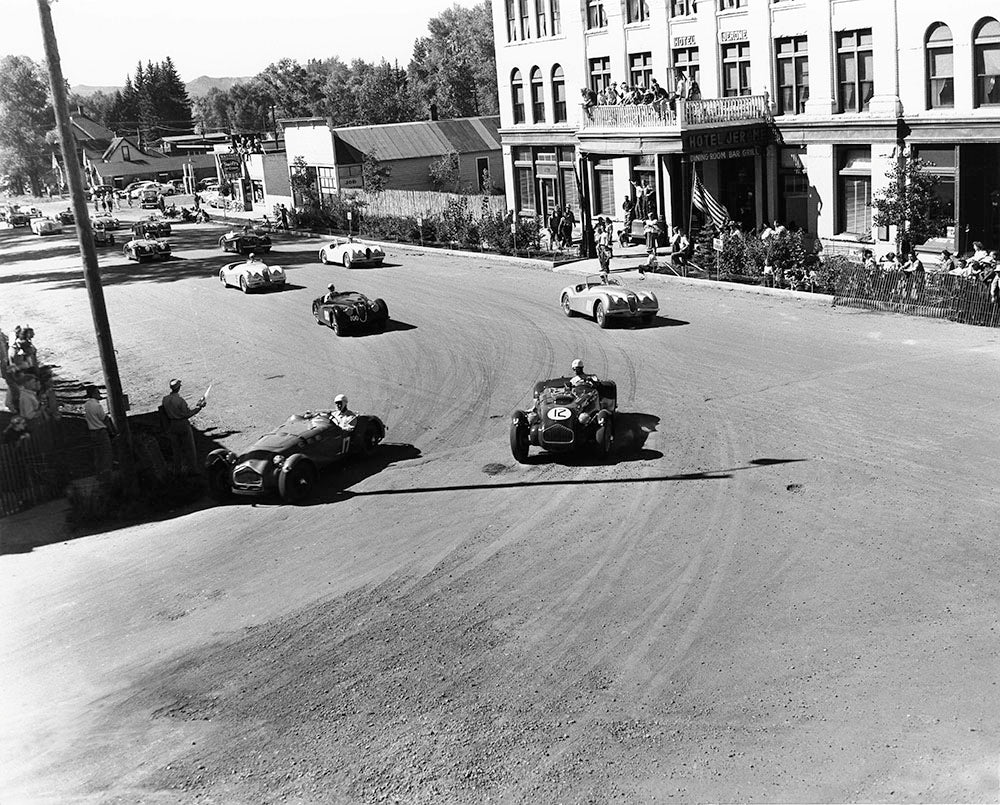
PC: Aspen Historical Society, The Johantgen Family Collection
It’s hard to imagine what life was like during the “Quiet Years” of Aspen — a time when life moved more slowly and the community worried about having enough commerce and activity following the fall of the Silver Standard and prior to the birth of skiing. This summer, with massive construction projects underway downtown and another packed high season in full swing, it’s hard to picture the community pushing for even more auto traffic during the warm-weather months. Yet if we look back to the 1950s, that’s exactly what was happening in our sometimes-sleepy little ski town.
For four years in the early ‘50s, Aspen had a moment of car craze with an auto race taking place on the dirt streets of downtown Aspen. This past weekend, racing fans watched Formula 1 tear through Spa-Francorchamps for the Belgian Grand Prix — a circuit that, like Aspen’s old street course, previously closed public roads and draws spectators from around the world for a weekend of speed. F1’s calendar has only grown more American in recent years: Miami, Austin, and Las Vegas now give the United States three Grand Prix weekends, more than any other country on the schedule. It’s hard not to wonder what if…

PC: Aspen Historical Society, Aspen Illustrated News Collection
The aesthetic beauty of the Roaring Fork Valley and the thrill of driving mountain roads was already increasing the popularity of auto rallies passing through town in the 1940s. However, it was a legendary mischief-making Aspen doctor, and former mayor, with a love of sports cars that solidified Aspen’s place on the auto-racing calendar. Dr. Robert “Bugsy” Barnard (later lovingly memorialized by Aspen writer Martie Sterling as “a sodbuster, a gunslinger and a vigilante in an era of space technology”) was already infamous in Aspen when he convinced the town’s mayor to approve the races. For four years in a row (and for a fifth time in 1957), Aspen was in the national spotlight for the Wild West Aspen Car Race.
The racecourse featured a start/finish straight down Main Street past the Hotel Jerome, and racers rallied around some of Aspen’s iconic streets, including Hopkins and Galena, allegedly reaching speeds of 100 mph. The event grew year over year and eventually included a full weekend of events, including a Jeep race up Aspen Mountain, a women’s-specific race, and even a blindfolded race in Wagner Park. Spectators filled stands lining Main Street, and fans got to see all the cars close-up before the race in an auto-show display open to the public. Despite the event’s continued success, everything came to a screeching halt in 1955 when Colorado’s governor forbade such use of public roads.

PC: Aspen Historical Society, Dr. "Slats Cabbage" ASTC Collection
Aspen’s need for speed didn’t die with the end of the Wild West Aspen Car Race. The 1960s brought on a smaller race weekend at the base of Aspen Highlands and the birth of the Woody Creek Raceway, which still operates today. That very racetrack even hosted a spontaneous demolition derby in the early ‘70s that truly embodied the spirit of old Aspen, with locals ramming their “town cars” into each other in a last-car-running battle of attrition where the only rule was no crashing into an opponent’s driver’s panel. “As punctured tires hissed flat and radiators steamed, local rivalries played out, leaving disabled clunkers strewn about,” reported the Aspen Daily News. One of the participants had to bulldoze all the old wrecks off the track once the dust had settled.
Today, most of the talk about cars in Aspen is focused on parking spots, the roundabout, and the S-curve entrance to town. But with F1 fever running hotter in America than ever, some of us still dream about what it would be like to watch Ferrari, Mercedes, and Red Bull battle at 200 mph past the Hotel Jerome. We’re all for bringing racing back to Aspen — but maybe let’s start with the 24 Hours of Aspen when the snow’s flying.